By Zulfikar

May Allah guide those who reads what is written here to connect with the Quran.
When I started to learn how to recite the Quran properly, a whole new dimension opened up for me.
The act of reciting the Quran is often perceived primarily as an act of devotion, a transmission of divine guidance from page to heart. While this sacred dimension is undeniably important, I find that to limit our understanding to this sphere is to overlook a profound and holistic discipline that focuses simultaneously on physical, artistic, and deeply psychological levels.
Ever since my dearest teacher made tajweed – the art of precise Quranic recitation – the primary focus while reciting the Quran, I find that much like the dedicated practice of martial arts, yoga, or mastering a musical instrument, it is rigorous, transformative “workout” for the entire human instrument.
It is actually a systematic art form demanding control, cultivating awareness, and unlocking states of being that resonate far beyond the audible verses, offering a unique pathway to internal harmony and connection.
Breath as the Engine
I quickly realized this recitation cannot be done passively. Reciting correctly became a surprisingly physical endeavor, a demanding “workout” I hadn’t anticipated.
Every act requires focus, control and awareness. I learned that proper, sustained recitation starts deep within.
Drawing breath deliberately from my diaphragm, not shallowly from my chest, became essential.
Holding a long madd (vowel elongation), navigating a complex sequence of rules within one breath, or pausing strategically (waqf) required conscious breath control unlike anything in everyday speech.
Breath became a foundational force, one that I appreciated more from reciting the Quran properly. Breath wasn’t just functional, it becomes a source of deep internal calm, a centering anchor in the midst of recitation.
Precision of Articulation
What perhaps was the most fascinating discovery was that each Arabic letter demanded exact placement.
The emphatic Daad (ض) required my tongue pressed firmly against my upper molars.
The deep guttural Haa (ح) originated from a very specific point in my throat.
Differentiating the subtle hiss of seen (س) from the fuller resonance of saad (ص), or the nuances between tha (ث), dhal (ذ), and zaa (ز), involved minute, conscious adjustments of my tongue, lips, jaw, and throat muscles.
I felt like an athlete training fine motor skills, or a musician learning exact finger placements. This act becomes a full workout for the intricate musculature of the face, throat, and tongue.
Posture and Resonance
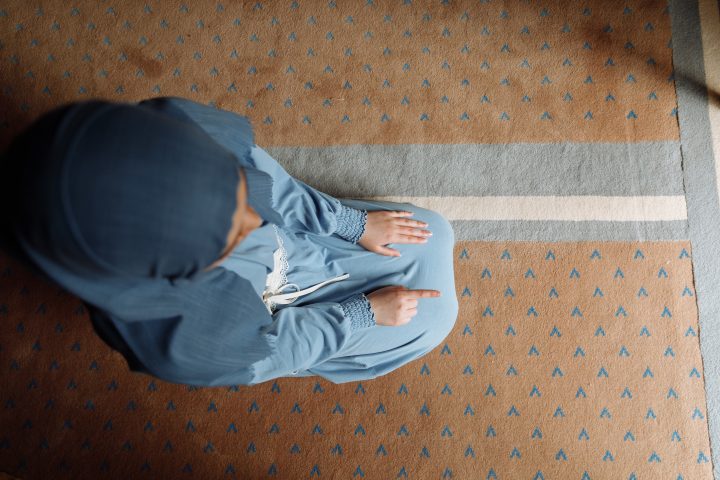
While reciting over time and trying to hit my the proper Mahraj and Harakat, I felt instinctively sitting in a certain posture allowed my diaphragm to move freely and my voice to resonate fully within my chest cavity.
I naturally found myself sitting straighter, shoulders relaxed, spine aligned. I am able to achieve more control and clearer recitation from this place of physical alignment.
My body starts to become an active participant in the recitation by “aligning itself” to the recitation of the Divine Word.
Melodic Scales of Tajweed
As the mechanics became more familiar, I realized that there is something deeper within such action, there was an artform of sorts hidden within.
Reciting within the rigorous framework of tajweed transformed from a duty into a deeply satisfying artistic practice, echoing my experiences learning music.
Mastering the rules wasn’t dry memorization; it was like learning the scales and chords of a profound musical composition.
Understanding the why behind an idgham (assimilation), the exact duration of a madd, or the subtle nasalization of ghunnah gave me the tools to unlock the Quran’s inherent sonic beauty and ensure its pristine transmission.
Drilling these rules became a meditative practice in precision, which I come to slowly appreciate.
Elusive Flow State
Then sometimes, it happened. The conscious effort would fade, replaced by a sense of flow. Hitting the perfect ghunnah, elongating a madd with resonant beauty, transitioning smoothly between maqamat in response to the verse’s emotion – these moments became pure, intrinsic joy.
At times, the recitations flowed through me, and instead of reciting, it’s as if I became the sound itself. Is this how it feels like to connect with teh Quran?
Such experiences lead to profound and deep artistic expression grounded in reverence.
What hit me the most was that the most profound discovery was how this holistic practice which demands physical control, mental focus and engagement with divine meaning actually became a gateway to altered states of consciousness and deep inner connection.
The sheer concentration required was transformative. Monitoring my breath, ensuring each letter’s makhraj, following the melody, while simultaneously holding the meaning in my heart.
I start to find myself entering a state of heightened awareness and pure presence focused entirely on the now of the recitation as if it was meditation.
When done in a sustained period over time (an hour or so), the physical discipline, the artistic flow, the focused mind, and the resonating heart align, a profound shift occurs.
Self-consciousness diminishes.
The sense of me performing the recitation recedes. The recitation feels less like something I do and more like a state I am in. It becomes a state of pure connection that transcends any description.
The deep rhythmic breathing, the focused concentration and vibrations within the chest cavity…it is as if I have discovered physiological harmony, leaving a pervasive sense of calm, clarity and centeredness that lingers.
Over time, what began as just recitation of the holy book, became a journey of discovery. I discovered that the Quran’s recitation, practiced with intention and precision, is ingeniously designed.
IF TAKEN SERIOUSLY AND WITH FOCUS, RECITATION OF THE QURAN CAN BE BOTH A WORKOUT AS WELL AS A SENSE OF ENJOYMENT AS ONE WOULD WHEN ENGAGING IN AN ARTFORM.
It is a physical workout, demanding mastery of breath and articulation. It is an artistic pursuit, refining focus, timing, and emotional expression.
And ultimately, it is a spiritual system, a structured pathway leading to states of profound inner peace, heightened awareness, and direct connection with the Divine essence within myself and beyond.
May Allah guide all of us to achieve deeper states and meaning as we connect with the Quran daily.
Do You Believe in One God
& Ready to [Re]start your Journey of Faith & Gratitude as a Muslim?


CONGRATULATIONS ON BECOMING A MUSLIM!
Drop us a message
we will guide you further on the next steps, InshaAllah!
ALL ARE WELCOME!
NON-MUSLIMS, NEW MUSLIMS, REDISCOVERING MUSLIMS, SEASONED MUSLIMS
Join us with your family & friends for our
Circles of Revision, Remembrance & Reflection
SEEKERS’ CIRCLE
IMAN & IHSAN : PERFECTING FAITH
- Every Tuesdays
- 730pm to 10pm
- Masjid Abdul Gafoor | 41 Dunlop St, Singapore 209369 | MPH Basement
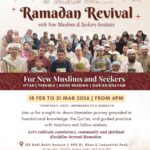
NEW MUSLIMS’ CIRCLE
ISLAM & IMAN : FAITH & PRACTICE
- Every Fridays
- 730pm to 10pm
- Masjid Abdul Gafoor | 41 Dunlop St, Singapore 209369 | MPH Basement
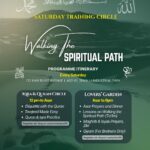
QURAN CIRCLE
PEER LEARNING CIRCLE
- Every Saturdays
- 2pm to 4pm
- Masjid Wak Tanjong | 25 Paya Lebar Road, Singapore 409004 | Basement







Follow Us