

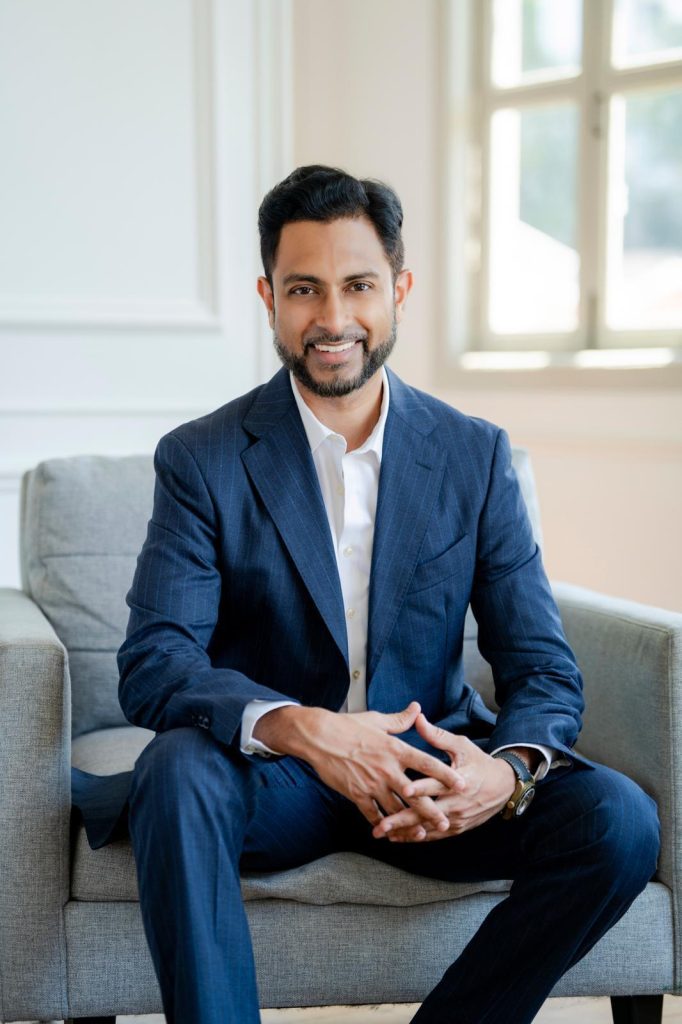
By Dr Nijam Latiff

Being born into a Muslim family, one of the first phrases I learned was
La Ilaha Illallah — “There is no one worthy of worship except God.”
As I have come to learn in recent times the English translation of La Ilaha Illallah does not quite do justice to the phrase. The basic English translation of this is a foundational statement, introducing the concept of Tawheed — the Oneness of Allah.
But, as one delves deeper into the spiritual path, it becomes clear that La Ilaha Illallah is not just to describe the oneness of God but to instill in our hearts that Allah ﷻ is our Creator, Lord and Sustainer, and every act that occurs through His creation can only occur as a result of His Will and Grace. He provides for us, nurtures us, forgives our shortcomings and is part of our lives in every aspect.
The Quranic phrase, and ‘we are closer to you than your jugular vein’ begins to hold a whole new meaning.
A deeper understanding of La Ilaha Illallah then becomes a transition from mere intellectual understanding to a deep, felt awareness of Allah’s presence.
This is the type of knowledge we must all strive for: not just knowledge of the mind, but knowledge that is experienced by the heart.
“And We are closer to them than their jugular vein”
Quran 50:16
The many names of Allah ﷻ reflect the various dimensions of our relationship with Him. He is Ar-Rabb — our Lord, Master, and Sustainer. This makes us His abd — His servant, His slave.
And yet, in this submission lies true freedom. For when we surrender to Allah ﷻ, we are no longer enslaved by our careers, the pursuit of wealth, the chase for fame, or the addictions and attachments of this world. Ar-Raheem — the Most Compassionate, the Most Merciful — comes from the Arabic root rahm, which also means a mother’s womb.
Just as an unborn child is completely unaware of the world beyond the womb and has no idea where its sustenance comes from, we too live in a world where our provisions are given to us without full comprehension.
Though we often think that our salaries, shelter, and success come from our own efforts or from others, in truth, it is all part of Allah’s divine plan, flowing from His infinite Mercy and Wisdom. Our life, our knowledge, our will, our power, our sight, our hearing, and our ability to speak — all of it is a mercy from Allah ﷻ. None of it is truly ours. We could not lift a single finger without His permission.
And yet, in the world we live in, this reality is often forgotten.
From a young age, we are told to study hard to succeed. As we accumulate achievements, we begin to believe that our success is purely the result of our own efforts.
This mindset carries into adulthood: the harder we work, the more we earn. The more we hustle, the more we are rewarded.
We hear phrases like “Mind over matter,” “Be the master of your destiny,” and “Manifest your success.”
These messages, while temporarily motivating, often leave the heart hollow. Because a heart devoid of the remembrance of Allah ﷻ is a heart that is spiritually ill.
Islam does not discourage striving. On the contrary, it encourages excellence in both worldly and spiritual pursuits. But it teaches us that success is not earned — it is granted. Even our failures, if they bring us closer to Allah ﷻ, are blessings in disguise.
To seek forgiveness, to learn from our mistakes, and to believe with conviction that anything is possible through Allah’s Mercy — this is the spiritual wisdom that brings lasting peace.
Today, we are living through a mental health crisis. Depression is one of the leading causes of disability worldwide, and suicide is one of the leading causes of death among younger people globally.
This calls for a radical redefinition of success. It’s time to shift our focus from material gain, constant competition, and the pursuit of validation — toward a deeper connection with our Creator, towards seeking sincere teachers, and forming meaningful relationships that nurture our faith.
True submission to Allah ﷻ means letting go of the illusion of control — a concept deeply counterintuitive in today’s world.
We find comfort in managing our finances, careers, and relationships. And while some level of control is necessary, the belief that we alone are responsible for every outcome breeds anxiety and restlessness.
For years, I believed the common idea: that our thoughts shape our actions, our actions form habits, and our habits define our character. But how much control do we really have over our thoughts?
In psychology and neuroscience, there is a concept called thought intrusions — unwanted negative thoughts that seem to arise from nowhere.
In the 1980s, neuroscientist Benjamin Libet conducted a series of experiments that challenged our understanding of free will. He discovered that brain activity related to decision-making began 300 to 500 milliseconds before a person became consciously aware of their intention to act.
Based on this, he proposed that while we may not have full free will, we
do possess what he called “free won’t” — the conscious ability to veto or suppress an action before it occurs. More recent research in neuroscience and microbiology supports the idea that our gut microbiome significantly influences our neurochemistry, impacting both mood and decision-making.
This growing scientific insight aligns remarkably with the Islamic understanding of waswas — the whisperings of Shaytan that aim to influence our thoughts and behaviour.
In Islam, the antidote to waswas is simple: sincere remembrance of Allah ﷻ (dhikr) and specific duas that seek His protection.
While we may not always be in control of the thoughts that
enter our minds, we are responsible for the ones we entertain. The power to say “no” to harmful impulses — that free won’t — is a mercy and a gift from Allah ﷻ.
We strive to follow the Sunnah of our beloved Prophet Muhammad ﷺ — to emulate him not only in prayer and worship, but also in how he lived among the people. We look to his example in the way he communicated with gentleness, conducted his business with integrity, upheld his responsibilities as a loving father and husband, and led his community with wisdom, humility, and justice.
But above all, we seek to be inspired by his unwavering devotion to Allah ﷻ in every moment of his life.
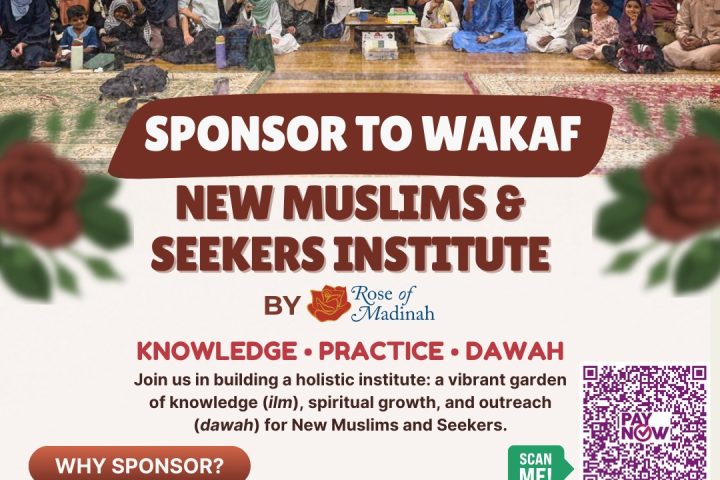
I am deeply grateful to Rose of Madinah which is led by Ustaz Sameer and our Sheikh, who have helped me uncover the beauty and depth of Islam in ways I never knew I needed. Their guidance has taught me that knowledge is not simply the acquisition of information — it is the beginning of transformation.
And such transformation only comes through sincere intention, sound mentorship, and the infinite mercy of Allah ﷻ. May we all be granted knowledge that enlightens our hearts, brings peace to our souls, and draws us closer to our Creator.
Ameen, Ya Rabb al-Alameen
Do You Believe in One God
& Ready to [Re]start your Journey of Faith & Gratitude as a Muslim?


CONGRATULATIONS ON BECOMING A MUSLIM!
Drop us a message
we will guide you further on the next steps, InshaAllah!
ALL ARE WELCOME!
NON-MUSLIMS, NEW MUSLIMS, REDISCOVERING MUSLIMS, SEASONED MUSLIMS
Join us with your family & friends for our
Circles of Revision, Remembrance & Reflection
SEEKERS’ CIRCLE
IMAN & IHSAN : PERFECTING FAITH
- Every Tuesdays
- 730pm to 10pm
- Masjid Abdul Gafoor | 41 Dunlop St, Singapore 209369 | MPH Basement
NEW MUSLIMS’ CIRCLE
ISLAM & IMAN : FAITH & PRACTICE
- Every Fridays
- 730pm to 10pm
- Masjid Abdul Gafoor | 41 Dunlop St, Singapore 209369 | MPH Basement
QURAN CIRCLE
PEER LEARNING CIRCLE
- Every Saturdays
- 2pm to 4pm
- Masjid Wak Tanjong | 25 Paya Lebar Road, Singapore 409004 | Basement










Follow Us